Goblins
The Portable DoorGoblins are intelligent supernatural beings who live alongside human society and have their own community, family ties, and interests. In the story, they are not merely creatures from a frightening book: they dictate office correspondence, occupy tunnels beneath a workplace, own the building leased by J.W. Wells & Co., and sometimes appear in forms that conceal what they are. Their varied roles make them both part of the firm’s everyday operations and a challenge to its human employees’ assumptions about appearance, danger, and belonging.
Appearance and Recognition
The contrast between fairy-tale image and living presence shapes the first encounters with Goblins. Sophie Pettingell remembers a picture in a fairy-tale book of a Goblin associated with frightening children; seeing a Goblin who resembles that illustration brings back her childhood nightmares. The recollection supplies a human frame for recognizing the beings, but the actual Goblins are not confined to the role of storybook monsters.
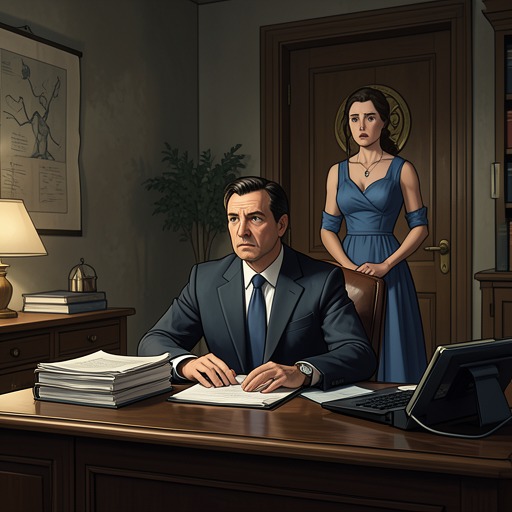
Paul Carpenter encounters one at a desk across from him. The Goblin is dressed in a grey silk Italian suit and an incongruous tie, and holds a spiral-bound notebook and pencil while waiting for Paul to continue dictating a letter. The juxtaposition is deliberately ordinary: a figure Paul identifies through a fairy-tale likeness is also performing clerical work in an office. Its presence turns the supernatural into something encountered amid routine business rather than safely contained in a childhood book.
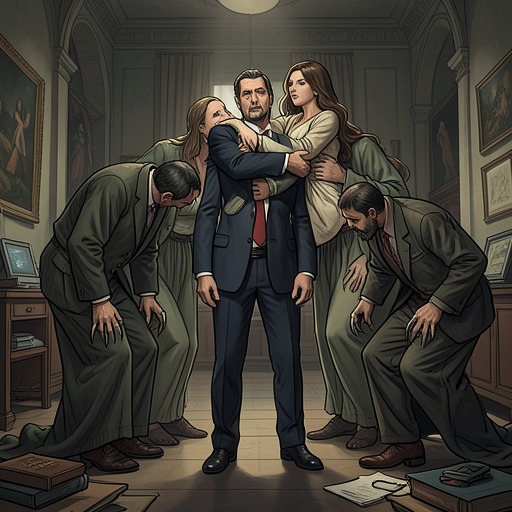
A later confrontation presents a more intimidating appearance: a tall, thin, monkey-like figure in a leather jerkin, a rust-marked chain-mail shirt, and a badly fitting steel helmet, carrying a short axe. Paul recognizes the figure as something outside his previous experience, while its pig-like face and round red eyes recall something he has seen before. That visual recognition gives way to a direct encounter with Goblins in the office. At least twenty are gathered there, using the large metal waste-paper basket from beneath the receptionist’s desk as a ball in a game. When Paul rushes in, they stop and stare at him. The reversal of perspective matters: in the Goblins’ workplace, Paul is the unexpected outsider.
The Colony and the Firm
The Goblins’ relationship with J.W. Wells & Co. is institutional as well as personal. Dennis Tanner explains that the Goblins own the premises. The firm rents the building from them for a nominal payment, under an arrangement that gives the Goblins access to the tunnels where they live after the doors have been locked. They can then come out and move around the building. The office is therefore not simply human territory occasionally invaded by supernatural visitors; it is property shared under terms that acknowledge the Goblins’ prior claim and needs.
That agreement changes how employees are expected to interpret an encounter. Dennis Tanner warns Paul and Sophie that frightening Goblins can make them panic, whereas leaving them alone is unlikely to bring trouble. He particularly stresses that this colony should not be antagonized because its members are the firm’s landlords. The advice joins social judgment to practical self-interest: the Goblins are not an abstract threat but a community with a legal and material relationship to the company. Their access after closing is part of the bargain, not an inexplicable intrusion.
The arrangement also makes the company’s apparent control less complete than its offices and procedures might suggest. J.W. Wells & Co. occupies the building as a tenant, while the Goblins retain ownership and use of the tunnels. The firm depends on an accommodation with beings its employees may initially imagine only through frightening tales. That dependence gives the Goblins leverage without requiring them to hold conventional office positions or seek permission from the human staff.
Work, Family, and Daily Conduct
Goblins appear within the working life of the firm in more than one way. The suited Goblin taking notes is already engaged in an office task when Paul notices him. The scene does not treat clerical work as incompatible with Goblin identity: formal clothes, a notebook, and a pencil coexist with the features that identify the figure as supernatural. Elsewhere, Dennis Tanner describes members of his family gathering printed readings from the Mortensen Counters after hours. Rather than leaving the reports neatly stacked, they play with the sheets; some are eaten or used in place of toilet paper, leaving employees to collect and sort the remaining papers the next morning. The incident makes the supernatural firm’s information systems dependent not only on machines and staff but also on the unruly habits of a Goblin family.
The family connections extend beyond these office routines. A Goblin called George is described as a cousin of Dennis Tanner, though the exact degree of kinship is uncertain. Sophie reports that George believed Dennis’s mother had prompted him to help keep Paul and Sophie apart, so that she could pursue Paul herself. The account presents this as a reported explanation for George’s involvement, not as a general rule about Goblin conduct. It nevertheless places the human romantic conflict inside a network of Goblin kinship and competing intentions.
Dennis Tanner’s mother also speaks openly about the freedom she claims as a Goblin. She describes choosing how she appears, including maintaining a desirable humanlike appearance or adopting a blonde one, and dismisses the idea that the chosen surface makes her human. Her remarks connect appearance to agency: a Goblin may present a form that attracts human attention while remaining aware that the form is only an appearance. She also challenges Paul’s suspicion of Goblins by pointing to Goblin women’s attraction to humans. Her perspective makes relations between the two groups more reciprocal than the fearful human stereotype allows, even as her teasing of Paul shows that the exchange can be pointed and uncomfortable.
Difference, Deception, and Misjudgment
The Goblins’ capacity to choose an appearance makes recognition uncertain. Dennis Tanner’s mother insists that a chosen look does not simply wash away or change on its own; it is something she can keep or alter by choice. Her claim resists treating visible appearance as reliable proof of underlying identity. In the office, clothing already complicates first impressions: a Goblin can look like a conventional professional while remaining unmistakably nonhuman to Paul once he notices the details. In the more personal encounters, an attractive appearance can likewise conceal a Goblin identity without erasing the individual behind it.
The story pairs this uncertainty with repeated acts of misjudgment. Sophie initially understands Goblins through a childhood tale, and the office Goblins’ response to Paul turns his own expectations back on him: he arrives as though he is entering their space to deal with them, only to find himself the startling presence. Dennis Tanner’s warning adds a practical correction to fear. Goblins may react badly when frightened, but the colony is not described as seeking conflict when left alone. The distinction between possible danger and unavoidable hostility matters; the firm’s need is to manage a relationship, not to reduce an entire community to a monster image.
Goblins consequently occupy several positions at once: they are workers, kin, inhabitants, owners, and neighbors whose interests do not always align with those of the humans around them. Their comic disorder with office reports and their capacity to unsettle human expectations belong to the same portrayal. By placing them inside leases, clerical tasks, workplace routines, and romantic schemes, the narrative makes the supernatural part of social life rather than an exception to it. The result is a community that can be frightening to outsiders, but cannot be understood simply by looking at its faces or recalling a fairy-tale picture.